The Thirty-Sixth Anniversary
Part I
Dear Readers: This article, by its nature of covering the incident in a detail form is long. I have divided it in two parts. This is the part I, and part II will be coming your way in a couple of weeks’ time.
There are points in life that should never be compromised, changed, or ignored. Downing Iran Air flight of 655 was such an occasion. Irrespective of our feelings toward the Government of Iran, their unaccepted governing concept should have never been used as a reason for downing a commercial airliner. What happened was the most hostile act of a superpower against the people of Iran, not its Government. This incident placed the U.S. in a terroristic position.
What you will be reading in this note was written on paper long ago. I promised myself that I would publish the article in each July, and I failed completely. This July, I prioritized it and placed the piece for all to read. It represents the event’s timetable and discusses the incident which ended with the shooting down of the Iranian airliner, and causing the death of 290 people, including children and women. The unbelievable action of the U.S. Government and its military that followed the incident is mindboggling.
The Iraq-Iran War, which started with Iraq’s attack on Iran (September 22, 1980), lasted for about eight years. The covert and overt support of the United States for Iraqis made the situation worse[1]. As a result of hostility, Persian Gulf became the center of the conflict. Therefore, the transportation of oil for the free world suffered. The waterway was inundated with tankers, commercial ships and warships from every country: the United States, Great Britain, France, Italian, Belgians, Saudis, and Iranians. The area became one of the most dangerous places of the time. There were concerns among the people about the safety of the civilians traveling about in the Persian Gulf States. Now, with these words, I shall present the article in the fashion described below for a better understanding:
- Prelude:
In October of 1987, the journal of “The Khaleej[2] -The Dubai Time”, in its editorial, expressed its concerns about what was taking place in the Persian Gulf traffic by stating: “One shudder to think of what would happen if an airline was mistaken for a hostile warplane or a warplane tried to take advantage of the presence of an airliner to carry out a military operation.” A problem so clear to a newspaper, apparently never crossed the minds of the big admirals running the show.
There were several near misses which had occurred during wartime over the Persian Gulf. On June 8, 1988, at 20:47 local time, a British Airways flight entered the control area of Dubai. At the same time, a Balkan Airlines flight was taking off from Sharjah. The British Airway was almost passing over an American Warship. The American ship ordered the flight to change courses and placed her on the path of the Balkan flight. It was the prompt action of the Dubai controller, who interfered in time and averted a tragedy. The Dubai controllers were unhappy, about the way the American navy was performing. They were asking, “Why don’t they just call us; it is easy. We can tell them all about the bloody aircraft; have these guys ever seen a radar screen before; we do wonder.[3]” This action was an unfortunate phenomenon that kept presenting itself repeatedly.
Iran Air had commuter flights between Bandar Abbas and Dubai. The flight was 140 miles long, during which, the plane would climb to an altitude of 14,000 and descend for landing. The aircrafts had to use the 25-mile-wide air corridor, a safe passageway for all civilian airliners. What is being discussed here is one of the saddest incidents that occurred in the Persian Gulf involving an American warship and Iran Air flight 655 on the morning of July 3, 1988.
The United States Navy was the most visible foreign power in the Persian Gulf. The American navy ships were protecting the oil tankers. The U.S. had to reflag Kuwaitis’ ships to protect them from Iranian navy’s attack. Persian Gulf became a gauntlet.
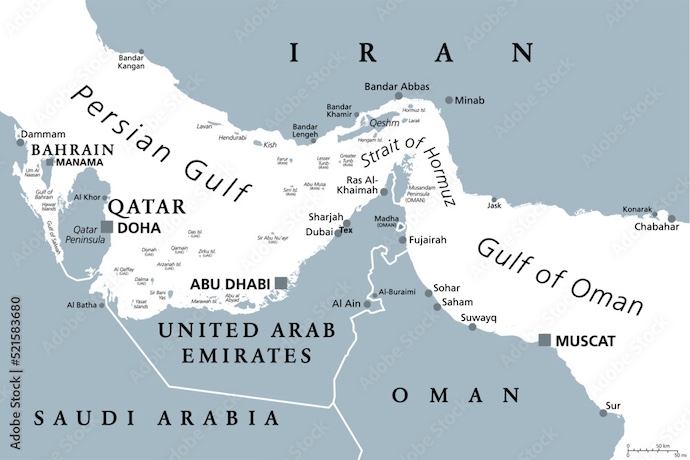
The Persian Gulf / The Strait of Hormuz / and the Gulf of Oman
The American presence in the Persian Gulf was not only for the safe passage of the tankers, but they were actively pursuing a hidden agenda, helping Iraq against Iran, despite their pretense of neutrality. After the incident of Stark, hit with two missiles launched by Iraqi fighters, killing 37 Americans, for some unknown and unusual reason, Washington became closer to Baghdad (May 17, 1987). All through the war, American military personnel, stationed in Baghdad, with the help of the U.S. fleet in the Persian Gulf, were helping the Iraqi planes to hit their targets in Iran. The Iraqis indiscriminate air raids caused tremendous casualties and deaths among the Iranian.
July 3, 1988, was another high-tension day in the Persian Gulf. At the local time, 6:33 AM, the USS Vincennes’s commander, Captain Will Roger, was informed by the ship’s Combat Information Center (CIC) that the battleship Montgomery “has her nose in a beehive.” Navy frigate Montgomery was some 50 miles away, coming through the western entrance of the Strait of Hormuz. This Strait is the narrow portion of the Persian Gulf and is only 32 miles wide at its choke point. Montgomery had spotted 13 Iranian gunboats in the Strait, several milling near a Liberian tanker, Stoval. At 7:22 AM, Montgomery reported explosions in the vicinity of the tanker. Receiving this information at the headquarters in Bahrain, Rear Admiral Anthony Less, commander of the joint Taskforce-Middle East, ordered the cruiser Vincennes to go northeast in support of Montgomery.
Admiral Less wanted Vincennes to avoid getting involved, and merely to use its helicopter for obtaining the needed information. The order was given to Captain Roger by Captain Richard McKenna, Chief of surface warfare of Rear Admiral Less, “Send your helo north to investigate, but keep your ship farther south.”
The helicopter found Iranian gunboats hovering around a Pakistani cargo ship. It did not notice any hostile activities or shots being fired; it was just a harassment. In the meantime, after receiving the news at the headquarters in Bahrain, it felt like the crisis was over. However, in Vincennes, the situation was shaping differently. Captain Rogers, known among his colleagues as a trigger-happy officer with practically no combat experience. He was unhappy with the events, and his hope for engagement with Iranians was evaporating.
By 8:30 AM, Vincennes was in Oman’s water, maneuvering at about thirty knots (very fast). The Omani Coast Guard told Vincennes, “Maneuvering at a speed of 30 knots in our territorial waters is not considered an act of “innocent passage, ” Please leave Omani water.” A Navy cameraman, Rudy Pahoyo, videoed the officers’ response to the Omani’s request, demonstrating them smirking at each other.
At 8:40 AM, Captain McKenna realized that Vincennes was on the top of Omani peninsula, some 40 miles north of where it was ordered to be. Enraged, he ordered Vincennes and the USS Frigate Montgomery to return where they were told to be. Rogers reluctantly obeyed the order but left his helicopter behind to watch Iranian boats. According to experts, this was a fatal mistake that brought about the disaster that followed.
At the USS Vincennes things were taking place differently. Contrary to the order given to Mark Collier, the helicopter Ocean Lord 25’s pilot, he decided to follow Iranian boats returning to their base. He continued his reckless action and began descending to get awaybetter view of the boats. This procedure made Iranians believe that it was preparing for an attack, and they began to shoot. At this time, the copilot, Scott Zilge, who realized the magnitude of the problem they created, screamed, “Let’s get out of here; that was an airburst antiaircraft fire.” After reaching a safe position, the aircraft’s commander, Lieutenant Roger Huff, sitting in the copilot’s seat, radioed the Vincennes “Trinity Sword. This is Ocean Lord 25. We are taking fire. Executing evasion.”
Capitan Rogers got what he was waiting for. Now, he had a report indicating hostile action from the Iranian gunboats. Under the engagement rules, he could pursue the Iranian ships and destroy them all. From the Combat Information Center (CIC), he ordered “Full Power” and the Vincennes, once again forged to the north with a speed of thirty knots per hour (As a rule, the speed of the navy ship is classified and an arbitrary speed of 30 knots is used for all of them)
Meanwhile, during this incident, the aircraft carrier USS Forestall was some 200 miles away in the southeast of Vincennes, just inside the mouth of the Gulf of Oman. The ship was under the command of Rear Admiral Leighton Smith. The ship was monitoring what was going on with Vincennes. Admiral Smith ordered the launch of two F-14s and two A-7 attack planes. By 9:28 AM, all four planes were airborne. Smith wanted his aircraft to refrain from getting engaged in fighting. They were told to meet at the rendezvous place, Point Alpha, about fifty miles outside of the Strait of Hormuz. In this case, they would be about seven minutes away from Vincennes.
Vincennes, the one-billion-dollar ship, was equipped with the most sophisticated, modern, and state-of-the-art equipment with a price tag of 400,000,000.00 Dollars. It was built for the Cold War era and could fight the most up-to-date enemy warships or planes. Her Aegis system was unique. However, it was not the proper ship to fight the tiny crafts; even a bunch of them would be too small to be recognized on its radar screen. Therefore, Rogers asked his tactical action officer, Lt. Commander Victor Guillory, if anything could be seen from the bridge. The answer was not entirely convincing; he could not be sure.
At 9:39, Rogers radioed fleet headquarters and asked permission to open fire. He was questioned about his position and the bearing of the gunboats, and finally, he was asked if the targets were clearing the area. Rogers gave evasive answers to these questions. The testimony later revealed that he continued to argue for permission to shoot the Iranian ships. He was told from the bridge that they could see some launches turning “this way and that way.” For Rodger, this was the news that he was waiting for. Roger reported the situation to Bahrain, telling them the gunboats were gathering and moving toward Vincennes. He again requested permission to fire. Finally, from headquarters, Admiral Less agreed with Rogers’ demand.
At 9:41 AM from Vincennes’ bridge, the chief quartermaster called, “Wow, Vincennes has crossed the twelve-mile limit off the coast into Iranian water.” The cruiser violated international law. However, to Capitan Rogers, it was inconsequential where his boat was; he wanted to destroy everything belonging to enemies, especially their gunboats. Commander Guillory ordered to fire, and the ship’s five-inch guns opened on its first target, 8000 feet away.
From twenty-five miles away, Captain David Carlson (Cruiser Sides), listening to Vincennes, was astounded to why the cruiser was where she was not supposed to be.
B-The Shooting:
At 9:55 AM, some 50 miles away, at the Iranian port of Bandar Abbas, Iran Air Flight 655 was ready to take off for its short journey, known as, ” The Milk Run,” to Dubai; it was twenty minutes behind the schedule. The ship was under the command of Captain Mohsen Rezaian, an American-trained pilot with seven thousand hours of flying experience. He informed the tower of their readiness for take-off and received permission. The plane’s direction was to fly southwest to its destination. Unaware that this path would take the aircraft directly above the Vincennes, on the place that the ship had no right to be.
It was at 9:47 AM that Vincennes’ radar picked up a blip far away. It was Iran Air’s flight 655, an A 300 B2 Airbus. Flight 655 was equipped with a transponder emitting the IFF (Identify Friend or Foe) in mode III, indicating that the carrier was a commercial flight. These airbuses are large, with a length of 177 feet, a wingspan of 147 feet, and weighing 170,000.00 pounds. In contrast, an F-14 is about a third of its size, with a length of 62 feet, a wingspan of 38 feet, and a weight of 48,000.00 pounds.
Meanwhile, at CIC, petty officer Andrew Anderson saw the blip on the screen. He asked the Aegis system whether the blip was a friend or foe. On his flight board, Anderson was unable to find flight 655. Later, it was discovered that flight board was not updated, and therefore could not identify the latest flights. Incompetent people placed in positions of responsibility that requires intelligence.
Anderson, unable to find a scheduled commercial flight, concluded the blip must be coming from an F-4 or an F–14. The findings and the concern were relied to Lt. Clay Zocher, their chief. Zocher informed Lt. Commander Scott Lusting, the technical commander for air warfare. Lusting ordered Zocher to warn the incoming plane. The warning consisted of transmitting to the unidentified plane, stating: “Unidentified aircraft, you are approaching a United States naval warship in International water.” This act of notification was a standard procedure.
Rogers’ obsession with engaging the enemy clouded his mind and judgment if he ever possessed one. His only concern was to find an excuse and to get involved with the enemy. On the other hand, Forrestal’s radar screen showed the blip, and his staff reported to Admiral Smith that it was a commercial plane.
Captain Rogers was busy giving orders to shoot the gunboats. There was a great commotion at CIC. At 9:50 AM, someone said that the incoming plan may be an Astro, a code name for F-14. Anderson decided to check the IFF query. This time, he received a “Mode Two” transmitted by a military aircraft. Much later, when inquiries were made, it was found that Anderson did not reset the range of IFF on his device. Therefore, this second reading probably came from a military plane in the area.
Rogers was consumed with his fight against the gunboats, constantly ordering the crew to reload their guns and continue shooting. At this time, Lusting noted that the plane in question was 32 miles away. He asked Rogers, “What to do now”? Just about this time, another officer, Lt. William Mountford, warned that the plane was possibly a commercial airline. The confusion at CIC was caused by the lack of experience of its officers and crew and the unfitness of Captain Rogers as the commander. Petty officers Anderson and Leach gave false information about the plane being an F-14, descending and picking up speed. Anderson was shouting that the plane’s speed was 450 knots, its altitude was 7800 feet, and that it was descending, all wrong and were just the opposite. It could never be understood on what his assumption was based, on ignorance or on purpose. What would they do if it was a real war, and they were fighting an strong navy.
At 9:54 AM, when the plane was 11 miles away from Vincennes, Rogers ordered: “shoot it down.” The crew was so inexperienced that the gunner had repeatedly pushed the wrong button to release the missiles. Finally, Guillory had to do the job himself. At the same time, in the cockpit of the Iran Air 655, captain Rezaian was talking with Bandar Abbas, reporting his whereabouts, and had yet to hear any of Vincennes’s warnings, which were sent on the wrong frequencies, according to later reports. Within thirty seconds, the first missile blew the left wing of the aircraft. The cameraman Rudy Pahoyo captured the jubilee over the Vincennes. “Owe dead—Coming down— We had him dead on— Direct hit”. During this jubilee phase, someone on the bridge yelled, “The target can’t be an F-14; the wreckage falling from the sky are too big for an F-14”. Over the USS Montgomery, they noticed one of the engines attached to the wing plunging into the sea. Twenty miles away on the USS Sides, his radar man told Captain Carlson that the ship was a commercial aircraft, and he had it on his radar IFF mode three.
Considering his mission completed, Captain Rogers ordered Vincennes to turn around and head south.
End of Part I.
[1] – Christopher Dickey: Expats Travel through Arabia, From Tripoli to Tehran.
[2] – Khaleej means GULF/ the paper can be called “The Gulf Times of Dubai
[3] -Christopher Dickey: I am an expat who travels through Arabia from Tripoli to Tehran.
 Guils of Guilan