Events of 1939-1945 in Russia and Poland
Russian invasion of Ukraine continues without any consideration to the demise of innocents, and injuries to people who committed no crimes against Russians. Continuous bombardment of schools, hospitals and supposedly safe institutions has been Russia’s norms. Yet, the bewildered world is looking on, and believing that they can restrain Russia’s criminal activities by limiting their financial ability . Putin’s behavior in Ukraine does present numerous problems and has many facades and ramifications. Unfortunately, the media either did not pick up these problems or they did not occur to them as major elements. On the top of my concerns, in this matter and at the moment, is the status of many small countries neighboring Russia. Those that suffered in the hands of Russians and Soviets imperialism times and again. Countries like Finland, Lithuania, Latvia, and most importantly, Poland.
Let us take a step back in history and evaluate the situation between Russia and Poland. The Soviets, last invaded Poland at the onset of WWII. Their criminal actions against the Poles were despicable and lacked any trace of humanity or human integrity. A few days ago, I received a Polish memorial stamp depicting the portrait of a polish child during their sojourn in Iran in WWII. Most of those children were in Isfahan. A city named by the Poles “The City of Polish Children.” The stamp commemorated that occasion.
In my book, “Fire Beneath the Ashes, published in 2011 ” I elaborated on this subject,”. I feel that I shall revisit that chapter and recount for my readers the essence of what happened. During that war, under the Anglo-Soviet occupation, Iran was on the verge of famine. The British and Russians depleted Iranian food supplies by exporting it to their bases. Creating famine and causing people’s death is precisely what the British did in 1917-1919, causing the demise of about nine to ten million Iranians (half the country’s population), and committing the first holocaust of such magnitude
During the 1940’s famine, Iran asked for United States’ help in procuring grains, and sent its representatives, under the direction of Allah-Yar Saleh, to Washington for this purpose. Their efforts failed due to the sabotage by the British government. U.S. State Department totally ignored what its representative in Iran, Mr. Louise Dreyfus[1], had to say of the situation. U.S Secretary of State, Hull, placed more values on the British consular reports over what he ahd received from his own representative, making the US Dept. of State a subsidiary of the British Foreign Office!
WWII started on September 1, 1939, with Germany’s attack on Poland. On September 17, 1939, the Soviets attacked Poland from its eastern borders. Both Germany and Soviets had non-aggression pact with Poland. History showed us that a deal made with a strong nation does not match the value of the paper it is written.
Upon the occupation, the Soviets dislodged many Poles. The procedure took place in four phases: The first phase was in Feb. 1940. Russians exiled 250,000 Poles to Siberia. The second phase took place in April 1940; 300,000 Poles, including children and women, were relocated, mainly in Kazakhstan. The third phase occurred in June and July 1940, and Russians sent 400,000 to Archangelsk and Novosibirsk. The fourth phase took place in June 1941, Russians’ sent 280,000 of the Polish to different areas of Soviet Union. Overall, another 500,000 of educated Poles, including teachers and professionals, were relocated into other parts of the Soviets between 1939-1941. In total, Russians dispersed 1,730,000 Poles.
The recent news from Ukraine reports that Russians, again have transferring Ukrainians from the captive cities and localities to the mainland Russia; repeating their method of the 1940’s.
After Hitler’s attack on Russia on Sunday June 24 1941, Churchill and Stalin, the enemies of yesterday, became today’s friends. On the suggestion and insistence of Churchill, Stalin ordered to free the Poles from captivity, to create the free Polish Army. For this purpose, the Russians and the Poles signed a treaty in London. The pact was signed in the presence of the Prime Minister (Churchill) between England, Russia, and the prime minister of free Poland, on July 30, 1941. The signatories were Polish prime minister in exile General Skiroski and the Russian representative, I. Mayski. The ceremony was witnessed by British Foreign Secretary Anthony Eden and present was the British Prime Minister Winston Churchill. Soviets agreed to announce this decision to all Poles in Russia. However, they failed to do so, and many of them did not get this information, and out of despair, some of them accepted Russian citizenship.
The Poles suffered greatly during their captivity in Russia. Many perished as the consequences of hard labor, poor nutrition, and infectious diseases. Of the original 1,730,000, half lost their lives by the time of their release to Iran. After signing the London accord, Stalin ordered the release of the Polish General, Wladyslaw Anders, from the Lubyanka prison to head the Poles free army.
Polish passage through Iran came in one of the most inopportune time for the country. The nation was on the verge of famine. Their grain reserve was almost none. Yet, despite all these difficulties, they accepted hosting Poles on their departure to fight the Germans.
Russia never let the Allied and the Iranian government know of the exact number of the Poles arriving Iran. They hinted something in the order of a few thousand. Once they arrived at the Iranian borders, they were over 115,000. Of this group, there were 37,000 of general populace, 18,000 children, and the rest were young people making up the bulk of the military corp. Many of these people died due to long, laborious trips, lack of food, and diseases.
They were happy once they reached Iranian soil. At the Port of Pahlavi, Helena Woloch describes the occasion as follows: “Exhausted by hard labor and starvation- barely recognizable as human beings- we disembarked at the Port of Pahlavi, on the Caspian shores of northern Iran. There we knelt together in our thousands along the sandy shorelines to kiss the soil of Persia. We had escaped Siberia and were free at last. Finally, we had reached our longed-for Promised Land.[2]”
These newcomers brought with them the gift of typhus for the Iranians. The disease spread with lightning speed causing the demise of thousands of Iranians.
During that time, I was a student at the Iran-Shahr high school. It was located in a lovely section of town, close to its highly thought commercial area. It was a block away from the Istanbul and Lalehzar avenues. Usually, after completing the school day (4.00 PM), we would walk to those streets and enjoy the afternoon promenade. Almost, at all times, we would encounter a large number of Poles walking leisurely in those streets and enjoying the stroll.
Unfortunately, most of them could not speak English or French, but this handicap did not prevent us from asking them to have a cup of coffee or tea with us, which they would invariably accept.
The children arriving in Iran were not necessarily orphans. Many of them lost their parents during the shuffling in transportation from different parts of the Soviet. A group of them was lodged in Tehran. One of these locations was a royal garden, where the kids had an opportunity to play freely in a beautiful environment.
Commemorative stamp of Poland, depicting the
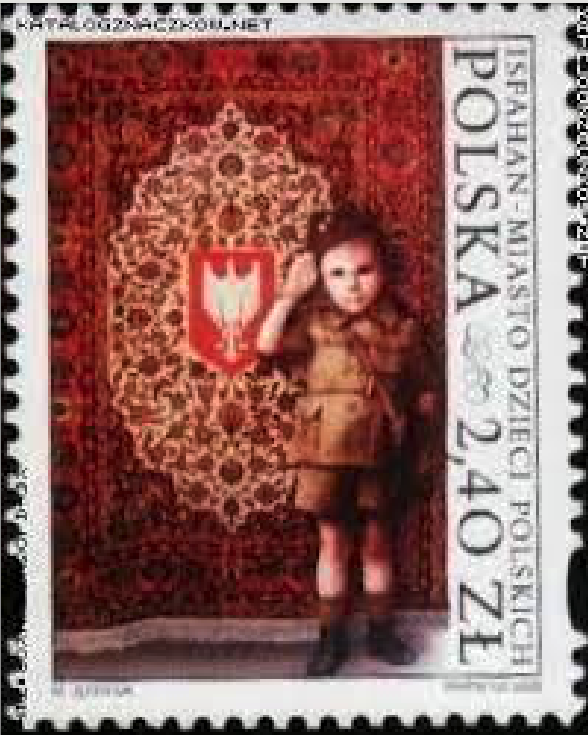
Polish child in Iran 1942-1945
The majority of the children were moved to Isfahan and were greeted warmly by the inhabitants. For this act of kindness, Isfahan got its nickname “City of Polish Children.”
Under Stanislaw Koscialkowski, the Poles created an organization to study Iran and Iranians history. This institution published many books and articles. In addition, the Poles made several newspapers and twenty-four schools for their children. Unfortunately, their stay in Iran ended between 1944-to 1945. The last group left Isfahan on October 12, 1945. Some of the Poles married Iranains and remained there.
At the Yalta Conference in 1945, the Allied decided to place Poland under the Soviet’s Domaine without consulting and considering the Poles’ inputs. General Anders, who created the second Polish Corp and had a magnificent records of victory over the Axis, protested the outcome of the Yalta conference. Churchill in response to his complaint told him “You (the Poles) are no longer needed.” The British did not invite Poles to attend London’s Victory Parade at the conclusion of the war! Did anyone expect otherwise of the British?
We should remember that many of the same countries who have suffered at the Russians’ hands are much concerned about what is going on in Europe today, especially with the virtual lack of willingness by the west to help them.
Also of interest is China’s behavior and what they are doing. It seems that they are observing the situation very, closely. Specially they are keen of actions taken by the Americans and the EU. They are probably calculating the risk factors for an open attack on Taiwan and other strategic places in the pacific!
Of course, we should remember the recent remark of Mr. Boris Johnson’s (British Prime Minister) about Russia’s attack on Crimea. He said it was a grave mistake that the West did not respond to Putin’s attack on Crimea in 2014! It is Too Late Now, Mr. Prime Minister!
[1] – Louis Dreyfus to Secretary Hull, Communique 598; June 18, 1942.
[2] – Ryszard Antolak: Exodus of Poles from Russia to Iran 1942, p. 15.
 Guils of Guilan