Geography: Geographically, the Persian Gulf (PG) is a body of water-limited in the north by the southern shores of Iran (the mainland); in the south and from west to east by Iraq, Kuwait, Saudi Arabia, Qatar, United Arab Emirates, and Oman. The Persian Gulf connects on the east to the Gulf of Oman, the Arabian Sea, and the Indian Ocean. It is about 990 Km. long (615 Miles), and its width varies from 340 Km. (210 Miles) to 55 Km. in the Strait of Hormuz.
Coastlines of the countries surrounding this waterbody are Iran 1536; Saudi Arabia 1300; United Arab Emirates 900; Qatar 563; Bahrain 161; Oman 100; and Iraq 58 Km.
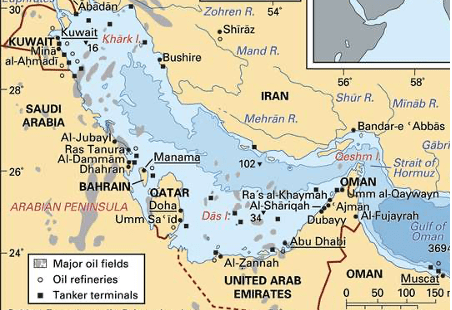
PG is a relatively shallow body of water. The deepest parts may reach up to 90 meters. It was geologically a river valley and wet marshland during the transition period between the last glacial maximum and the Holocene period. It was formed about 15000 years ago due to the Arabian Plate’s subduction under the Zagros Mountains due to rising sea levels in the Holocene glacial retreat period.
Commerce and its History: Before creating the Persian Empire over 2500 years ago, Sumerians, Babylonians, and Elamites used the Persian Gulf as means of trade to Syria and Alexandria in the West and India and China in the east. In the Islamic era, this waterway continued to remain a significant commercial trade road as it was in the past.
In the thirteenth century, Marco Polo passed through the Persian Gulf on his way back to Venice. Whether he ever used the Persian Gulf for any trade remains unknown.

In the first half of the 16th century, the Portuguese were masters of the sea and quite active in the Persian Gulf. In 1505, the Portuguese sovereign, King Manuel I, ordered Aden’s invasion. Adan, a city in Yamen, is located in the southwest corner of the country. By so doing, the Portuguese controlled trade through the Red Sea and Alexandria. They were also contemplating an attack on Hormuz Island to prevent Beirut’s business via the Persian Gulf. The Gulf of Adan connects the Red Sea to the Indian Ocean.

Political Aspects of the Persian Gulf: Ruling of the Portuguese: In 1507, Portuguese sailor Alfonso de Albuquerque landed on Hormuz Island. This kingdom became a Portuguese vassal state. However, there were several uprisings against the Portuguese. The ultimate control was established in 1515 by Albuquerque and lasted until 1622 AD.
In 1521, Hormuz’s vassal state joined the Portuguese and invaded Bahrain and took over the country, which brought Bahrein under the rules of Hormuz. This attack compromised the Jabrid family’s control over the Bahrain archipelago, and they had to pay tribute to Hormuz. The Portuguese ruled over Bahrain by governors from Hormuz.
In the early 17th century, there were numerous conflicts between Iran and the Portuguese. In 1602, Shah Abbas I sent his army under the command of Imam Gholi Khan and took over Bahrain. In 1612, the Portuguese took the city of Gamrun, translated to Comorao. In 1615 the town was retaken by the Iranians, and Shah Abbas rename it Bandar-e Abbas, The Port of Abbas.
Start of the British Supremacy in the Persian Gulf: Toward the end of the seventeenth century, the Portuguese rule over the Persian Gulf and the Indian Ocean decreased and replaced by the British. British recognized Iran as the Persian Gulf’s sole sovereign power in the Treaty of Friendship and Alliance of 1809. This part of the treaty changed in the final version in 1812 and the Treaty of Tehran in 1814.
In the nineteenth century, Britons made several political and commercial agreements with Iran, the first one signed on Dec. 29, 1800, the text giving 1801. In this treaty, the Iranian government’s primary responsibility was to support the British against any other country targeting India. On their part, the English agreed to supply Iran with armaments, that never materialized.
Then came the treaty of 1809, where the Iranian government agreed to continue the war (Russo-Iran War of 1804-1813) and break ties with the French. This agreement dictated by the British was designed only to help England. The English promised to supply Iran with military hard wears, again it never took place. On Oct. 28, 1841, Iran gave the British trading privileges like those given to the Russian after the second Russo-Iranian War. The last such unilateral agreement signed between the two countries was 1919, which was never ratified by Majlis and was nullified by the Iranian government in February 1921.
During the past two to three centuries, specifically during the Ghajar dynasty, Iran went through severe political upheavals, causing her weakness and increasing her dependency on foreign powers. The misery was brought to the nation by a symbiosis of the corrupt Shi’a leaders and incompetent and traitor sovereigns of the Ghajar dynasty. Russians took whatever they wanted in the north, and the British had no rivals in the south.
The British felt that the Persian Gulf was an essential part of their governing strategies in that part of the World, and specifically for maintaining the welfare of their prize possession, India. Therefore, they were keen on establishing an international ruling system to give them the necessary power to hold their position.
On June 17, 1925, the “International Trade in Armament and Ammunition Treaty” was signed in Geneva to prevent smuggling and transport of arms in international waters.[1] The British engineered the meeting to protect their interest, mostly by controlling the traffic in the primary waterways, specifically in the Middle East and the Mediterranean Sea. The League accepted the article. These waterways divide into two groups, prohibited and nonprohibited waters. The nonprohibited waters did not require policing, but the British could check all ships for arms transport in the first water category. The Persian Gulf was in the prohibited area, while the Suez Canal was in the nonprohibited waters; the British were masters of the Suez Canal, while the Persian Gulf was not entirely under their command.
The Iranian government opposed such a decision. It maintained that the control of the Persian Gulf water should remain in the Persian Gulf countries’ hands, and it stated that the Iranian navy should have control over this body of water. The British opposed this autonomy. They wanted to prevent any military supplies from reaching the Persian Gulf States that could threaten British authority.
On May 14, 1934, the Iranian Minister in Washington, Ghaffar Djalal, wrote to the US Secretary of State, Cordell Hull. He asked if Hull would delay submitting the Geneva resolution for Senate’s ratification in the form presented. The Secretary refused any cooperation with the Iranian representative. In a nutshell, Cordell acted as a British agent.
WWII and the American Entrance in the Persian Gulf: Britons made themselves the solely responsible power in PG and acted as Masters, doing whatever pleased them and served their interest. They made it impossible for Iran to participate in the Persian Gulf administration, including any roles in the waterways’ welfare and safety. Reza Shah tried diligently to get American support in several areas, including maintaining the Persian Gulf’s security. He could not succeed because of the enormous British influence over the American policymakers. The British held this power until the end of WWII and way past it.
There were multiple attempts made by the Iranian government during the 1920s, and thirties, and early forties when the occupation and invasion of Iran by Anglo-Russian forces took place. All these efforts failed, mainly because the Americans were unaware and unwilling to accept the British treacheries.
The importance of the PG grew exponentially in the early twentieth century when the British procured treaties to explore the area for oil. In 1901, William Knox Darcy, a British-Australian, made an agreement with Muzaffar-al-Din Shah of Iran with the payment of 20,000 Pounds for a sixty-year concession of oil exploration in Iran. This contract was the beginning of a century-long disaster for Iran. On May 26, 1908, their exploration efforts resulted in the discovery of oil.
The Anglo-Persian Oil Company, APOC, was formed, and D’Arcy became the chairman of the Board. The British government soon realized the importance of this discovery and invested in the APOC and became the major shareholder. Hence the Iranians had to deal with the British government for any disagreement with the company. The Persian Gulf became an essential route for transporting oil to the World’s Market.
In the early twenties, the British realized the benefits of using oil in their navy and began to make the necessary changes in all their ships.
Approximately in the same era, Americans found oil in Saudi Arabia. A little later, the Arabian American Oil Company, Aramco, was formed in 1933. These events made the PG more crucial than ever to world commerce.
The British enjoyed their rule over the area, disregarding every aspect of human suffering and humanity. Mistreating the company’s Iranian employees and their handling of the company’s administrative function constituted significant parts of the problems.
The Persian Gulf in the post-WWII era: After the war, Americans remained there and constituted a significant force. Despite many difficulties created by the American’s lack of understanding of foreign affairs, Iran and the USA’s relation remained strong. During the late 1940s and early 1950s, Iran endured tremendous pressure by the British refusal to accept the nation’s sovereignty over its resources and the Briton’s unwillingness to return Persian oil to its lawful owner, the Iranian people.
In the early time of the conflicts, the US government supported Iran’s demand; however, in 1952, Eisenhower was elected president. He was an easy subject to manipulate and tricked in removing the legitimate and democratically elected Iranian government in support of the Shah. Thus, the coup d’état of 1953 took place, with Americans playing a significant role in the event.
From that point on, Americans found a strong reason to remain in the area, seemingly to protect shipping through the PG waters. They managed to work with the Persian Gulf States, establishing numerous bases for their military forces: air force, navy, and army.
Over the decades, American forces in the area increased exponentially. US agreements with the Arab States to house its military included: the United Arab Emirates, accommodated around 5000 US Military personnel, many at Abu Dhabi’s Al Dhafra Airport. Bahrain became the center for the US 5th fleet with 7000 American troops. Americans have forces in place in Iraq after the occupation and invasion of that country. It should also add the US troops in Kuwait, Qatar, and part of Saudi. Overall, it seems that the US has over 35000 military personnel in the Persian Gulf area. Of course, this number changes from time to time.
From 1953 to 1978-79, Mohammad Reza Shah, the Iranian monarch, a protégée of the US, represented a sort, the Americans in the area. When President Carter decided to get rid of the Shah, he could not foresee the problems. Unfortunately, none of the American Governments had ever shown any keen intelligence about the political aspects of the Persian Gulf or the Middle-East. They were all subscribed to the idea that they could lead the World with the military force alone—a grave misunderstanding.
The second mistake of the Americans in a span of twenty-five years in Iran was the removal of Shah. Carter did not know about Mullah’s behavior. Like most American presidents, his total lack of awareness on the subject made him vulnerable to European deceptions, who had different agendas. Americans could not understand that the British were never their friends and that they disliked Shah immensely and were waiting for the right moment to remove him. The French, and the Germans, each had their ax to grind.
Almost every US government showed extreme ineptitude in understanding the Mullah’s motivations and actions. Iranian clergy’s sole goal has always been the same: preserving their existence and interests at any price. Over the past several years with Trump’s presidency, the Persian Gulf situation worsened. His policy, or rather the lack of it, boldened other power to enter the arena.
Role of Israel at the Persian Gulf and Iran:
Before going forward, it will be of utmost importance to clarify a few points that I have had defined in my previous writings: When we are using Israel’s word, it has nothing to do with Jewish people or the Jewish faith. Israel is a state, and we should address it as such. The Israeli hardliners propagate and perpetuate the thinking that Israel’s country is equivalent to Jewish people and the Jewish faith. Therefore, they would like to feel free to label anyone criticizing Israel’s State as antisemitic or name them as Jew-haters and or Jew killers. Thus far, that policy worked well. However, we are noticing that this attitude is backfiring, and among the people and not much in the governments, as yet.
Over the millennia, the Jewish people showed their intelligence and hard work and have done more in science, arts, music, and literature than any other ethnic group. I do not doubt that all fair-minded individuals agree on this point.
Also, criticizing the Israeli government does not mean that one is denouncing the Jewish people or the existence of a Jewish state. However, the Hardliners would like for the people to believe that this is the case. I have personally experienced these problems with some of my highly educated Jewish acquaintances.
Israel’s influence over the US government is indisputable, which is most apparent with Trump’s administration. The hold of the Israel hardliners over Congress of the United States is a known fact for decades.
There is no doubt that Israel had to strengthen its defense system and be alert for its safety at all times. However, they preferred the theory of domination over a peaceful coexistence. They consider any relatively strong nation in the region, a danger to them; this included the Shah of Iran as well. It was beyond any doubt that the Shah had a good rapport with them, and many Israeli experts were working in Iran.
With all that, the Tel Aviv hardliners did not wish to see Iran grow, and they did their utmost in preventing Washington from complying with Shah’s demands for armaments.
After the Mullah’s takeover in Iran, the animosity between the two nations reached its highest point. The Israeli lobby in Washington did everything to distance US from Iran; they are a significant force to bring an American attack on Iran, something like what has happened in Iraq. After Trump’s inauguration, the hardliners continue beating the same drum. They found the right ear for their concerns.
The Americans’ unilateral withdrawal from the nuclear deal and imposing stricter sanctions were what the Israelis wanted. Contrary to general belief, the nation’s embargo did not hurt Iran’s administration but became detrimental to the general population’s well-being. The poor people suffered and blamed the US for their miseries. This action achieved nothing constructive. The Europeans were happy to get rid of the Americans in the Persian Gulf.
The total lack of knowledge of the American government in the affairs of the Middle East, and their blind obedience to what the Israelis tell them, and their ignorance of the Muslim clergy’s behavior, were all contributing factors in destroying the US standing in that part of the World.
To combat Americans’ threat in the Persian Gulf, the Mullahs found a new ally: China. They made a twenty-five-year treaty with them. Iran granted China the right to bring 5000 soldiers to safeguard Chinese workers stationed at the Persian Gulf. The agreement’s complete words are not entirely known, but it reminds us of the Safavid era, with the Portuguese having similar power in the area. Undoubtedly, the poor tactics or, to say it better, the lack of understanding of the US government with the blessing of Israel’s hardliners threw Iran into Chinese arms.
There is only one take-home note here: “The United States lost its leadership in the area and gave China a big foothold in the Middle East. THE BEGINNING OF THE END.” No one can predict the next plan and what the Chinese government will do with all they can procure.
[1] – For complete details of this incident, the reader may look at the book, “Fire Beneath the Ashes-US/Iran Relations, by H. Guilak, 2011, pages 112-121.
 Guils of Guilan
Thank you Dr. Guilak for the summary and for gifting/helping us see the truth as painful as it maybe.
LikeLike
Dr. Guilak, I love the deep research on your article.
Excellent. I read it with great interest.
Thank you,
Farah Ramchandani
LikeLike