Decades ago, when I was a little boy and living in Tehran, my father would walk me to the school every morning. I remember, often, that I had to run after him to keep pace with his fast march.
In our way we would pass by a branch of the Ministry of Justice. It was an old house, probably belonging to a wealthy person or most likely to senior members of the royal family that that became vacant and sold for different purposes.
On the entrance of that building was a large sign made of blue tiles and inscribed “Ministry of Justice… Branch of….” In its middle was a painting, depicting what seemed to be an angel, blind folded, having a saber in her right hand and a scale in her left hand.
I was puzzled- what was the picture for, why blind folded, why she held the saber and the scale? I remember, that once I asked my father the meaning of such complex, he said: “Son, she is the angel of Justice. The blind fold means that she cannot see who are the persons involved, therefore she remains impartial; the scale means that she weighs the evidence presented in the court and that the Sword furnishes the power that proper justice is carried out.”

Decades later, when I was a grown man and traveled abroad to further my education, I saw many angels of justice with similar outfits, almost identical to what I had seen in my hometown long ago.
Years passed, and my attention to the angel of justice faded away. However, I regarded that people who render justice should represent no particular interests or groups and that those individuals should remain free of all political bias. To me the court should base its ruling on the merit of the case, and decisions must follow the law and our constitution.
In the past decade or so that the circumstances in our country changed drastically, regretfully for the worse. Partisanship among our elected officials reached a higher ceiling. One of the greatest center affected by such measure was our Supreme Court. Each party tried its utmost to appoint judges to the court who are inclined to serve better their purpose.
Once again, unconsciously, my thought went to the Angel of Justice and what she represents. Obsession consumed my faculty in finding more about this angel and how she came to represent Justice in a most degenerate commonality, known as the Human Society.
This time, I tried not to begin into the Greco-Roman history, which the Euro-Americans would so diligently refer to as their most precious source for any and everything of value, therefore not crediting other nations for the progress of Human endeavors.
To fulfill this task, I decided to go farther back and try to find whatever are needed to elucidate the sequence of events vis-à-vis the passage of time. The results were easily attained, even, by a cursory check. The Angel of Justice has a long history of existence among the nations, going back millenniums. It constitutes a religious connotation in its early forms, usually, judging the people after death, defining if their souls are or are not of heavenly materials.
The Egyptian Ma’at: Ancient Egyptians’ concept of Truth, Law, Order, and Justice. The earliest recording of Ma’at was found in the writings of the Fifth Dynasty, 2510-2370 BCE, and in the Pyramid Text of Unas in 2375-2345 BCE. As a Goddess, she was on the records of the Old Kingdome (2680-2190 BCE).
Ma’at, the Goddess of Truth and Justice, was a lady depicted either by wings on both arms or an ostrich feather on her head. The feather was used to judge the degree of guilt or innocence.
Ma’at represented ancient Egyptian concept of Truth, Law, Justice and Harmony. Later on, the priests charged with these responsibilities and they were called “The Priests of Ma’at.”


Iranian’s Angel of Justice: Like that of the Egyptian, this angel’s primary7 responsibility was judging the souls of the departed. The pre-Zoroastrian angel was Rashan or Rashnu. All these angels were called Yazatas. Another yazata was Asha or Arda and Arta in Indo-Iranian , meaning righteousness, law, and justice. She was to help the soul in overcoming the its problems. Asha, an Amesha Spenta, is the genius of truth in Young’s Avesta and is reported as Asha Vahishta (the best truth).
Rashan is recognized as the Zoroastrian yazatas, and was named long before Zoroaster. Thus, making her, at least over two thousand BCE. She would judge the souls of the departed’s on the Chinvat Bridge and to find out whether the soul belongs to heaven or not. To the Arians, the soul is a person’s inner self, or Daena. Daena (the soul) being the aggregate of the actions, deeds and thoughts of that individual during its lifetime.
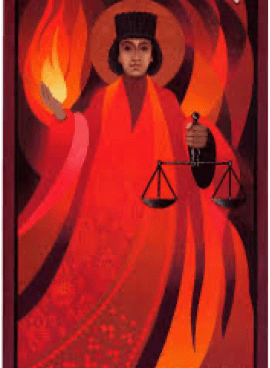
In Greek mythology, the gods have used as representing the justice. Greek goddess described in Hesiod’s Theogony was called Dike, the Goddess of Justice. She was the daughter of Zeus, who associated with human. Her mother Themis was associated with the divine justice.
In the Roman Empire, there is lady justice of the ancient Roman known as Lustitia, or Justitia. It was introduced by the Emperor Augustus, therefore not of an old Roman deity. In its present form, she has been represented in mid twelfth century. Presently it may come in different mode of wearing the toga, holding the sword and the scale and also blindfolded or not. However, at any shape it represents the impartiality and strength of the judiciary system.
In conclusion: What recently transpired in our country, and the procedure used to appoint a Justice to replace the departed one was anything but an act of disrespect of moral and ethics. How can we expect impartiality from an individual elected under political pressure? I am lost and hope that someone can come up with a reasonable response if any is at our grasp?
 Guils of Guilan